skip to main |
skip to sidebar

Given the huge potential in military avionics, Indian aerospace firm Axis Aerospace and Technologies (AAT) and Russian defence exporter FGUP Rosoboronexport Monday announced they have signed an agreement to start a joint venture focusing on avionics for IAF's front line Sukhoi SU-30 and MiG-29 fighter jets, as also military helicopters.
Apart from these Russian-origin platforms, the JV will also work on the new fighter jet from the Mikoyan stable, the MiG-35, which is one of the contenders in India's $10.4-billion tender for 126 combat aircraft.

'The JV will focus on creation of cutting-edge technology for aerospace and defence applications in addition to design, production and integration of avionics systems,' the two companies said, but did not give the funding details of the project.
The venture would address areas such as development of MIPS technology for use in avionics. This would be a major leap towards achieving self-reliance in processor technology for Indian industry.
Axis Aerospace would build on the Russian efforts in this field to create MIPS (million instructions per seconds)-based avionics, communication systems and software-defined radio (SDR). The JV would seamlessly fuse the building blocks of this technology held by both companies to design and produce SDRs, the future of all communication systems.
'The JV will undertake manufacture of avionics equipment for MiG-35, Su-30, MiG-29 (fighter jets), Mi-17, Mi-28, and Kamov-28 (helicopters) enabling better offset discharge by Russian original equipment manufacturers, apart from design and development of new generation test solutions for maintenance of avionics equipment,' city-based AAT's CEO Ravi Narayanan said here.
The venture would also take part in establishing a service centre in India for maintenance and repair of avionics equipment of Russian origin, apart from integration of the same on aircraft and helicopters of both Russian and non-Russian design, he added.
'This JV, once it is formed, will be the perfect vehicle to support indigenous efforts to develop, support and upgrade avionics and other types of equipment for Russian-origin defence product, which would continue to be the dominant factor in Indian defense for the years to come. Also this would marry Russian domain expertise, OEM knowledge along with cutting edge technology build to suit Indian requirements,' Narayanan said.
Rosoboronexport said the creation of such JV would make it possible to extend participation of the Russian companies in Indian defense programmes including advanced projects in the future.
Monday, 14 February 2011
08:56
Posted by
Cool wallpapers and View world beauty
,
0 Comments
Labels:
Asian Defence
,
INDIA
,
Military

The Indian Army has begun the process for acquiring heavy guns yet again, floating tenders for both the Towed and Tracked systems within January 2011.
The tender for the Towed gun was issued on January 28 while for the Tracked version, it was issued mid-January.
Sources said that several vendors, from France, US, Britain, Israel and Czechoslovakia and other countries, were invited but no details of the tender specifications were available as they are generally secret anyway in accordance with General Staff Qualitative Requirements (GSQRs).

India had earlier cancelled its Request for Proposal (RfP) for 1,580 towed guns (155mm, 52 calibre), as well as for tracked Guns over allegations of corruption involving one company or another. That set back the Army’s artillery modernisation programme by three to five years over and above the ten-year long delay in the process.
But the good news is that the summer and winter field trials of the ultralight gun, BAE Systems M 777 A1, have been completed successfully at the Pokhran range and now some negotiations are to be conducting for acquiring 145 of them from the US Government under its Foreign Military Sales (FMS) programme. The 155mm/45 caliber gun, which can be slung-carried by heavy lift helicopters like the Boeing Chinook, or ferried by heavy trucks, is to be deployed in the mountains.
The process to acquire this type of gun was initiated in 2006.
US Congressional clearance, a mandatory requirement, has already been given and the gun could be in the Indian Army’s inventory within a couple of years after the contract is signed. Made partly of titanium, the gun is about40 per cent lighter than the earlier versions in operation, and is being used extensively in Afghanistan by the US Army.
It has digital controls, can be move quickly after firing, and can deliver munitions up to 40 km. There would be limitations of terrain in the mountains however.
It may be recalled that the artillery had played a decisive role in demolishing Pakistani positions that they had intruded into in Kargil in the 1999 war. But somehow, thanks to the allegations of corruption over the acquisition of 400 Bofors FH 77B (155mm/39 caliber) guns from Sweden in the mid-1980s, the Indian Army has not been able to renew its inventory. The Bofors guns though played havoc with the Pakistanis.
Pakistan however has has acquired M-109 A5 155mm howitzers meanwhile from the United States.
The Indian Army needs to phase out all its medium and field guns, although there is a proposal to upgun the Soviet vintage 130 mm guns into 155 mm guns by replacing the barrel. Israel’s Soltam had assisted in this process with the barrles but only some of the guns have been upgunned, and their results are reported to be very good.
While there is no plan to make the ultralight gun in India, both the other proposals involve part purchase and part Transfer of Technology to make them in India. BAE Systems for this has tied up with the Mahindras, and the Czech with the state-run BEML.
The emphasis on the acquisition now is to go in for ToT, and then make the guns indigenously rather than under licence, the latter option inevitably coming with some restrictions.
It may be pointed out that the French have offered to give all the technology if India buys the Ceasar, described by French officials as “the best and most modern gun” now successfully being used in Afghanistan. They say that this gun can meet both the tracked and towed requirements.
Notably, all the guns with the Indian Army’s Artillery Regiment are obsolete, and it goes to its credit that despite this limitations, it keeps them in ready to fire position. Old Bofors, the (not so light) Light Field Gun, and the Soviet M 46 medium guns are in this obsolete list.
There is progress though on the rocket artillery with the indigenous Pinaka and Russian Smerch Multi Barrel Rocket Launchers (MBRLs) having been inducted.
One hopes this time, the RfP is replied to, the trials are held as required, the deal is done in time, and the guns are delivered ASAP. Artillery plays a potent, battle-winning role and its modernization cannot be delayed any further.
08:52
Posted by
Cool wallpapers and View world beauty
,
0 Comments
Labels:
INDIA
,
Military

Pakistan Air Force (PAF) has received third air to air refuelling aircraft from Ukraine, which is likely to reach here in the first week of February 2011, sources disclosed. PAF purchased a total of four IL-78P Midas tanker aircraft from Ukraine.
The third aircraft is likely to arrive in the first week of February. These aircraft are equipped with Soviet-designed UPAZs pods and refuelling kits on Mirage-III Rose-I of South African origin. In the first phase, PAF announced that 30 Mirage-III Rose-I will be upgraded with in-flight refuelling probes and this too, is being done at PAC Kamra. The IL-78s will help train Pakistani crew in mid-air refuelling techniques and once operational, will be used to refuel the Mirage-III, eventually JF-17 Thunder and Fc-20 fighter jets.

These IL-78 Midas mid-air refuelling aircraft will allow PAF to increase the range and endurance of its fighter aircraft. The capability will also allow Pakistan to hit targets deep inside enemy territory by refuelling fighter aircraft during flight. An official said that air-to-air refuelling will enhance PAF capability in military warfare allowing its aircraft long ranges. The first air to air refuelling aircraft joined the force in mid of December 2009. PAF is using IL-78 aircraft that it procured from Ukraine for refuelling purposes and immediately installed refuelling kits to save cost. It has been learnt that PAF operates around 45 F-16A/B that are being upgraded to F-16AM/BM along with 17 new F-16C/D Block 52. So far, PAF has not shown any interest in new conformal air refuel tank system for F-16s to make them capable of taking fuel from IL-78 as its old F-16A/B can not carry conformal fuel tanks.
08:49
Posted by
Cool wallpapers and View world beauty
,
0 Comments
Labels:
AirCrafts
,
Pakistan
,
Pakistan Air Force

Pakistan’s Prime Minister, Yousaf Raza Gilani extended the government’s complete support of the JF-17 Thunder aircraft program. PM said this project has proven to be a great positive in the Pak-China relationship.
“This is the project that can become a true flagship of the historic cooperation and strengthen the relationship between our two countries”. These were the words of Gilani as he addressed a gathering of Chinese and Pakistani technicians during his visitation to the JF-17 manufacturing facility at the Pakistan Aeronautical Complex.

He also expressed his satisfaction and pride of the successful progress of the JF-17 program and the fact that it is constantly completing milestones. The JF-17 project is definitely one of the biggest joint project going on between Pakistan and its strategic partner – China. Both governments expect that such cooperation will strengthen their time-tested relationship. Gilani said that every Pakistani is cherishing the help which China provides to the JF-17 program and a couple of other project. PM believes this project will write another glorious chapter in the history of the cooperation between the two countries.
Gilani wasn’t the only official visiting the factory, other names there were General Khalid Shameem Wynne, Chairman Joint Chiefs of Staff Committee and Air Chief Marshal Rao Qamar Suleman, Chief of the Air Staff of the Pakistan Air Force were also visitors of the factory. They had the opportunity to witness the amazing progress which the JF=17 aircraft manufacturing program has achieved.
The JF-17 project is one of the most ambitious Pakistani programs and it has successfully complete many milestones. Thanks to this program, Pakistan can now proudly stand amongst the group of countries which manufacture modern combat aircraft.

The JF-17 is one of the most cost-effective, multi-role combat aircraft and it is specifically designed to meet the needs of the Pakistan Air Force.
The first batch is expected to be of 50 JF-17 Thunder aircraft which are to be equipped with the Chinese radar and SD-10 Beyond Visual Range Missile. Later batches are expected to be equipped with a more advanced radar.
The JF-17 military program is not the only program Pakistan-China cooperate on, other programs include F-22p Frigate and ZDK-03, which consists of Chinese AESA radar mounted on the Y-8F600 platform.

September 30th, 2009: Pakistan Navy has acquired Anti Submarine Warfare (ASW) helicopters Z9EC from China. Induction ceremony was held Wednesday at Naval Aviation Base. Chief of Naval Staff Admiral Noman Bashir was chief guest. This is first batch of series of six helicopters to be procured as per the contract signed with M/s China National Aero Technology Import & Export Corporation (CATIC).
Z9EC helicopters have been built according to specific requirements of Pakistan Navy and capable to detect and destroy submarines. They are configured to carry torpedoes, fitted with state of art Pulse Compression Radar, Low Frequency Dipping Sonar, Radar Warning Receiver & Doppler Navigation System. Later talking to newsmen, Admiral Noman Bashir said these days Indian Ocean is experiencing intense activity and around 100 ships from different countries are operating at all times for safeguarding their interests. These extraordinary developments are indicator of importance of trade routes in these waters. Pakistan Navy is also conducting continuous deployment of ships and aircraft to guarantee guarding the country’s maritime interests, he stated.

Commenting on regional stability, Naval Chief denied being part of any arms race but expressed resolve to maintain quality in naval platforms and enhancement of capabilities in consonance with developments in the region. He expressed his full confidence in Chinese technology and termed it compatible to Western. "Pak-China relationship is time-tested and would further be strengthened with such defence collaborations like F-22 P frigates and Z9EC helicopters projects.’’ Commander Pakistan Fleet Rear Admiral Asif Sandila highlighted salient features of Z9EC project. Apart from China, Pakistan is first country that would be operating these helicopters in anti submarine warfare role. Later, helicopters made fly past and staged demonstration of its characteristics and maneuverability.
The ceremony was attended by Chinese ambassador to Pakistan Luo Zhao Hui, representatives of M/s CATIC, large number of senior naval officers and Aviators of Pakistan Navy.
11:03
Posted by
Cool wallpapers and View world beauty
,
0 Comments
Labels:
Helicopters
,
Pakistan Navy
,
Submarines
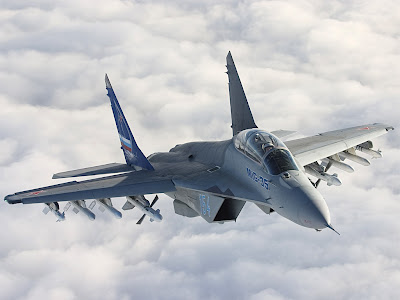
Russia exhibited over 80 types of weaponry at the upcoming Aero India 2011 air show, state-run arms exporter Rosoboronexport said in a statement, but the MiG-35 fighter jet did not take part.
Aero India-2011, which was held in the southern city of Bangalore on February 9-13, was expected to attract the record number of over 600 manufacturers, vendors and suppliers from 63 countries.
Russia was represented by 35 companies, including aircraft manufacturers MiG and Sukhoi, and air defense systems producers Almaz-Antei and Engineering Design Bureau (KBM).
AIRCRAFT
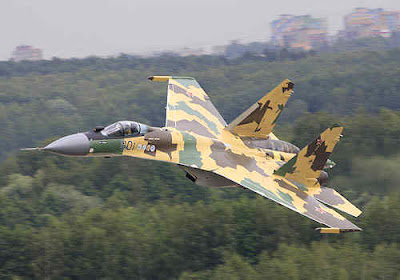
Russia promoteed its MiG-35 and Su-35 fighter jets, the Yak-130 combat trainer, two versions of the Il-76MD transport plane (with different engines), the Il-78MK aerial tanker and MiG-29K and MiG-29KUB naval fighters.
However, the MiG-35, which is a candidate in an Indian Air Force tender for 126 light fighter aircraft, will not take part in the show, MiG representatives in Delhi told RIA Novosti last week. Indian press articles last year claimed that the aircraft had unofficially been dropped from the shortlist of aircraft being considered,which Russian aerospace holding UAC denies.
The Be-200 amphibious aircraft was most likely one of the top attractions of the Russian exhibit as its popularity with foreign customers steadily grows. The Be-200 can be used in a wide variety of roles, from maritime reconnaissance and rescue to firefighting.
HELICOPTERS
Rosoboronexport and Russian Helicopters showed the Mi-28NE attack helicopter, the light multirole Ka-226T and the heavy transport Mi-26. All three helicopters are currently taking part in separate Indian helicopter tenders.
The visitors were also able to receive information about the Mi-35M combat transport helicopter, the Kamov Ka-31 radar surveillance helicopter and the Ansat and Kamov Ka-32A11BS multi-role helicopters.
AIR DEFENSE
The air defense part of the Russian exhibit was represented by the Tor-M2E, the S-300VM, the Buk-M2E and the Tunguska-M1 systems.
Russia's Engineering Design Bureau unveiled a new ultra short-range air defense system based on the Strelets multiple launcher for the portable Igla missiles.
Russia is the world's second largest conventional arms exporter after the United States. In 2010, Russian defense industry companies delivered about $10 billion worth of arms to foreign customers.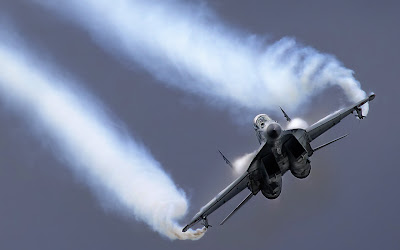

Saturday, 12 February 2011
07:20
Posted by
Cool wallpapers and View world beauty
,
0 Comments
Labels:
Aero Asia 2011
,
INDIA

The 8th International Exhibition on Aerospace, Defence and Civil Aviation Aero India 2011, which is one of the biggest among such events in Asia, is hosted at the Air Force Station Yelahanka in the suburbs of Bangaluru from 9th to 13th February 2011. The Federal State Unitary Enterprise Rosoboronexport, a regular participant in the air show, is promoting more than 80 items of weapons and military equipment.
Aerospace systems have always been a centrepiece in the defence cooperation between Russia and India. It was in 1964 when the first batch of the MiG-21 aircraft was delivered to India and our countries started then their modern-era military cooperation. The mutually advantageous collaboration has been maintained for decades, and is now raised to a strategic partnership level.
Last visit to India of Russian President Dmitri Medvedev testifies to the high status of our relations. A number of important agreements were signed, including a feasibility study contract for the Fifth Generation Fighter Aircraft (FGFA) development programme. That was a start of the joint programme implementation. Similar developments are also carried out by USA and China. Thanks to the cooperation with Russia, India can be justly classed now in their number.
Just as prospective is a development programme for the Multi-Role Transport Aircraft (MTA) which is planned to enter service with Air Forces of both countries in future. The aircraft is intended for active operation by both military services and commercial air lifting companies.

"We are moving up to deep-rooted cooperation and joint development of advanced systems. It does require a renewed level of trust. It is one thing to sell finished items or assemblе them by licence, and it is quite different to implement programmes such as the fifth generation fighter aircraft, transport aircraft MTA or BrahMos missiles. We have already started, as it is, a number of major programmes that will define future defence capabilities of our countries", - said Viktor Komardin, deputy director general of Rosoboronexport and head of delegation in India.
Russia was the first country which started transferring to India up-to-date aerospace, land and maritime equipment technologies. One of the most revealing examples is licence production of the Su-30MKI aircraft by Hindustan Aeronautics Limited. This modification of the fighter aircraft was developed by Russian manufacturers specifically to satisfy exacting requirements of the Indian Air Force. Su-30MKI proved to be a highly effective and reliable system. It is worthy of noting that in 2009 President of India Pratibha Patil made a flight on this fighter aircraft.
07:04
Posted by
Cool wallpapers and View world beauty
,
0 Comments
Labels:
Aero Asia 2011
,
INDIA


